Monet’s house and gardens in Giverny: the complete guide
In short: Claude Monet’s house and gardens are open from April 1st to November 1st, from 10 a.m. to 6 p.m., and take 1.5 to 2 hours to visit. The Clos Normand, the water garden with the Japanese bridge, and the pink house are seen in that order. The water lilies bloom from late June to September. From Paris, you can choose between taking the train to Vernon-Giverny followed by an on-site guided tour or a coach or minibus excursion that includes admission.
I’ve been guiding groups at Giverny for fifteen years, and every season I see the same disappointments: visitors who come “to see the water lilies” on April 20th, families who discover the queue outside the house at 1 p.m., Parisians who learn in Vernon that their Navigo pass isn’t valid here. This guide helps avoid those three mistakes.
What you’ll see, in detail
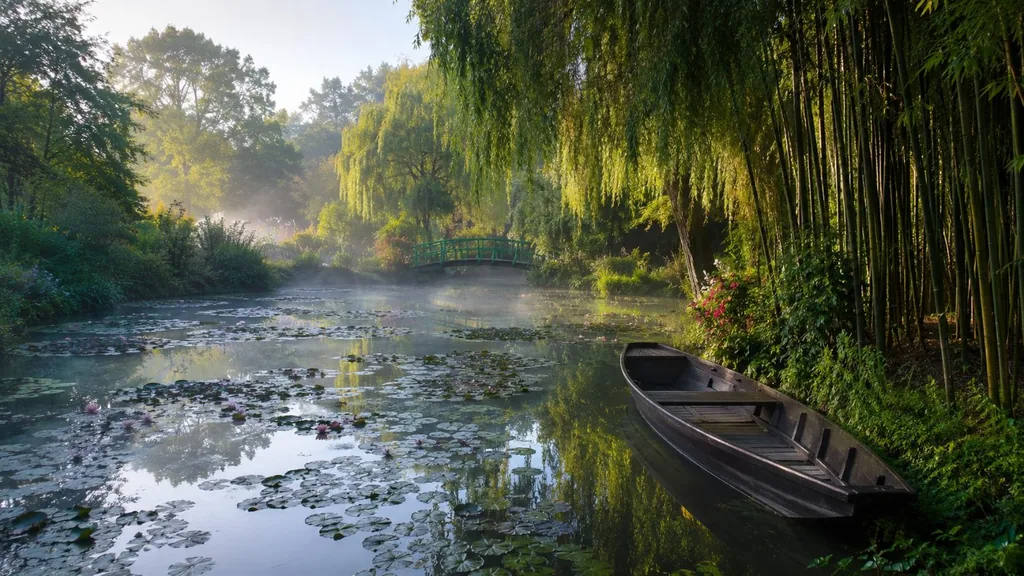
The estate spans two plots separated by the road. In front of the house is the Clos Normand: a flower garden with straight paths, the grand alley under its arches, thousands of plants, and over a hundred varieties that bloom in succession from April to October. On the other side, accessed by an underground passage, is the water garden that Monet had dug in 1893 beyond the old railway line: the green Japanese bridge, the pond enlarged around 1901–1910, the willows, the bamboo, and about 70 varieties of water lilies. The pink house with green shutters is then explored: the blue sitting room, the yellow dining room, the kitchen with Rouen blue tiles, the upstairs bedrooms, and 243 Japanese prints hung in nearly every room. You exit through the gift shop, set up in the first studio. The large *Water Lilies* studio, built in 1915, is also open to visitors.
The best time slot, no detours
The site is open from April 1st to November 1st, every day, from 10 a.m. to 6 p.m., with last admission at 5:30 p.m. The rest of the year, the gates are closed, and there’s nothing to negotiate. For the month, it depends on what you want to see: tulips, daffodils, and irises in April–May; wisteria on the bridge in May; roses and poppies in June; water lilies from late June to September, peaking in July–August; dahlias and nasturtiums in the grand alley in September–October. The last week of October is the quietest I know, with soft light all day. For the time, only two choices: 10 a.m. sharp with a timed ticket, or after 4 p.m. Between 11 a.m. and 4 p.m., from mid-May to late August, the site is at full capacity, and coaches arrive in waves between 10:30 a.m. and 11:30 a.m. The month-by-month details are on the best time to visit page.

The water garden early in the morning
This is the advice I repeat the most. If you enter at 10 a.m., don’t follow the crowd toward the house: cross the Clos Normand without stopping, take the underground passage, and walk around the pond while the paths are still empty. Water lily flowers open in the morning and close in the late afternoon; each one lasts three to five days. Then head back to the house, and return to the Clos Normand flowerbeds when everyone has gone for lunch.
The house is small
Let’s be clear: it’s a family home, not a château. The corridors are narrow, the staircases too, and the route is one-way. When two coaches unload at the same time, visiting the house becomes a slow-moving queue. It’s not wheelchair-accessible, unlike the water garden, which you can reach via the main gate, avoiding the tunnel. There’s no cloakroom; luggage must fit in cabin-sized bags, and any exit is final. Picnicking is not allowed on the premises, nor are painting or drawing; the meadow near the car park and the banks of the Epte are just a short walk away. The rest of the rules are in tickets and skip-the-line.
Train or excursion?
By train: from Paris Saint-Lazare, take the TER to Rouen and get off at Vernon-Giverny in about 45 minutes, then take the shuttle (around fifteen minutes, with schedules timed to match the trains), rent a bike at the station, or walk for 1 hour 15 minutes along the greenway. The Navigo pass doesn’t cover this journey, as Vernon is in Normandy. This option gives you the freedom to choose your time and pace, which is the key argument for arriving at 10 a.m. By car, allow 1 hour 15 to 1 hour 30 via the A13, exit Vernon/Giverny, with free parking. The coach excursion from Paris takes care of everything for you, including entry, but drops you off at the busiest time of day. It suits those who don’t want to deal with connections, not those who want the water garden to themselves. The three departure options are on excursion from Paris, and train details are on how to get to Giverny.
What a guide brings
The gardens speak for themselves, but the house does not. A guide explains why the dining room is yellow, who Alice Hoschedé was and why ten people lived here, how cataracts turned Monet’s final canvases red, and what Clemenceau was doing at the funeral in December 1926. They also take you through a separate entrance: the on-site guided tour, limited to ten people and given in French or English, lasts 2 hours and is reserved for those who arrive independently. On excursions, the guide is English-speaking, and the commentary at Giverny is provided via an audio guide app. Compare and read visitor feedback on the guided tour of Giverny and in our reviews.
The village and the grave
Save half an hour for rue Claude-Monet. The Hôtel Baudy, where the American painters stayed, is still there; the Musée des Impressionnismes, 300 metres away, isn’t included in any of the six options. At the end of the village, a ten-minute walk away, the cemetery of Sainte-Radegonde church is home to the Hoschedé-Monet vault, where Monet has rested since December 1926 after a civil ceremony. Excursions make a brief stop here; if you come by train, visit at the end of your trip, when it’s quiet. The full story of the family and the legacy entrusted by Michel Monet to the Académie des Beaux-Arts is in Monet in Giverny.
Claire Vasseur, guide-lecturer in Vernon.
Ready to book?
The half-day excursion from Paris is the most popular option; availability is shown below. To compare all six options, see all visits, and to choose your date, check the best time to visit.
Frequently asked questions
How much time should you allow to visit Giverny?
Allow 1 hour 30 to 2 hours for the house and the two gardens, plus half an hour for the village and Monet’s grave at Sainte-Radegonde church. Details are on the visit duration page.
Do you need a guide to visit Monet’s house?
No, the visit is self-guided. A guide provides context that the panels don’t (the prints, the cataracts, the Hoschedé family) and, on-site, skip-the-line access via a separate entrance. See the on-site guided tour.
What’s the best way to get to Giverny from Paris?
Take the train from Saint-Lazare to Vernon-Giverny (about 45 minutes), then the shuttle, or opt for a coach excursion that includes entry. Both options are detailed on how to get to Giverny.